
The permit test has a reputation for trick questions. In practice, most misses come from ordinary questions read too quickly. The exam often uses “except,” “best,” “minimum” and “not” to change the correct answer without changing the topic.
One reliable fix is to slow down before answering, not after. Read the entire question, cover the answer choices, say the answer in your own words, then look for the choice that matches. That sequence costs five extra seconds and prevents most avoidable errors.
Four DMV permit test question shapes that cause trouble
The “except” question. “Which of the following is not a reason to adjust your mirrors?” Three choices are true; one is false. If you scan for a familiar phrase, you will pick a true statement. Underline the negative word in your mind before reading the choices.
The “best” question. More than one answer may be legal. The exam wants the safest response. When a pedestrian is waiting at a crosswalk, “slow down and proceed” may be legal in a state, but “stop and yield” is the safer answer the test is looking for.
The number question. Following distance, blood alcohol limits and parking distances are common. These numbers vary by state and by vehicle type. Learn the numbers in your own handbook, not from a generic quiz app.
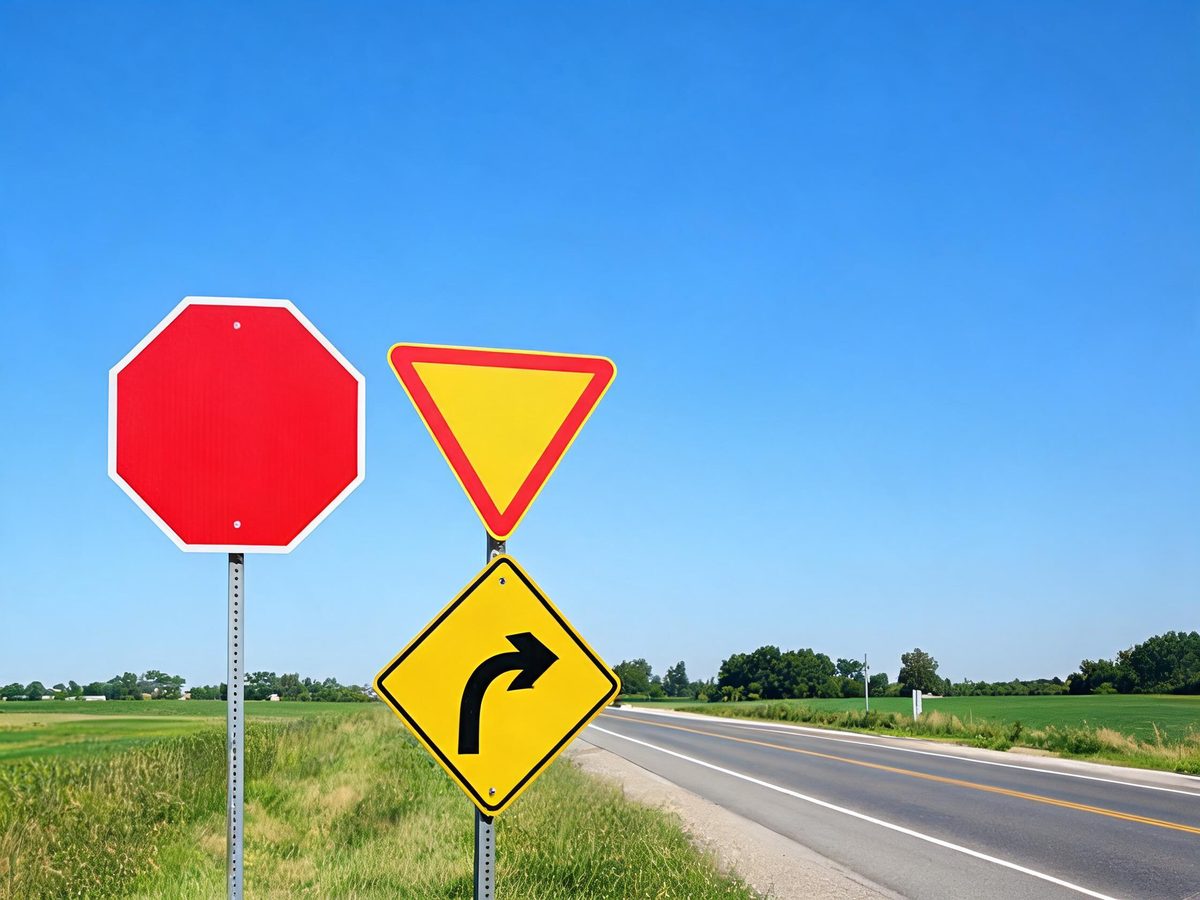
The sign question. A yellow diamond is a warning. A red octagon is a stop. An orange diamond is construction. A white rectangle with black text is usually a regulatory sign. Learn shape and color first, then the specific symbol.

DMV permit test rules people unlearn the hard way
Right-of-way is not a courtesy contest. At a four-way stop, the first vehicle to arrive goes first. If two arrive at the same time, the vehicle on the right goes first, unless one is turning left across traffic. Do not wave someone through; predictable behavior is safer.
Following distance is a rule of thumb. The “three-second rule” is common advice, not a universal legal standard. In rain, at night, or behind a truck, leave more space. On an exam, choose the answer that increases distance.
A flashing yellow light is not a stop. Slow down and proceed with caution. A flashing red light is a stop sign. This pair shows up often because candidates memorize colors without the flash pattern.
School buses have their own rules. Many states require you to stop for a school bus with flashing red lights on an undivided road. Divided highways may have exceptions. Learn your state's exact language.
Parking near a corner. The distance from a stop sign, crosswalk or fire hydrant is usually stated in feet. Do not guess. If the handbook says 15 feet, the test expects 15.
How to study for the DMV permit test without memorizing answers
Practice tests are useful for format, not for content. If you memorize the answer key, a reworded question will beat you. Use practice tests to find weak topics, then go back to the handbook section for that topic.
- Make a one-page list of every number in the handbook: distances, speeds, limits, ages.
- Make a second page of every “except” rule: who does not have to stop, which vehicles are exempt, where the rule does not apply.
- Read each sign description aloud and sketch the shape. Visual memory is faster than text memory under time pressure.
- Take one practice test the night before, then stop. Cramming new material at midnight creates confusion, not confidence.
At the testing station for your DMV permit test
Bring the required documents and arrive with enough time to settle. The exam is usually taken at a computer; some states offer a paper version. If you fail, many states require a short wait before a retest, but the rules differ.
Read each question twice. If a question references a sign, look at the sign image before reading the choices. If two answers seem correct, choose the safer, more conservative option. The permit test is designed to reward caution, not cleverness.
Some states let you take the knowledge test in a different language or with an audio version. Ask the office in advance if you need either. Accommodation requests are usually handled before the appointment, not at the counter.
A last DMV permit test check before you submit
If the test allows you to review answers, do it. Look specifically for questions with “not,” “except” or “minimum.” Those are the ones where a rushed answer goes wrong. If you truly do not know, choose the answer that reduces risk. Then move on; second-guessing every question wastes time you need for the next one.
The reading habits that get you through the permit exam transfer to the road test, where a missed sign costs more than a wrong answer.
Sources and further reading
About the author
Maya Ortiz
Maya reports on licensing, road rules and the paperwork that slows people down. Her work for Vextor Times focuses on what state agencies actually ask for, and what happens when a form is missing.
Driving and consumer rules · Sacramento, California